Photometric Photodiode Sensor
Photometric Photodiode Sensor
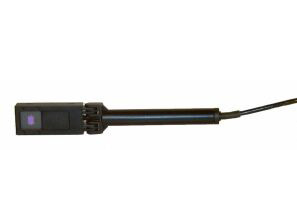
The PD300-CIE is a photometric sensor with swivel mount. It has an eye response curve sensor and measures in units of Lux. Its measurement range is from 20 mLux to 200 kLux.
- Eye response curve sensor with units of Lux
- 20 mLux to 200 kLux range
- Swivel mount
- The PD300-CIE sensor is not under ISO/IEC 17025:2017 accreditation See All Features
Specifications
- Aperture Size2.4 x 2.8 mm
- MaterialSilicon
- Spectral Range400-700 nm
- Power Range20 mLux to 200 kLux
- Maximum Average Power Density10 W/cm²
- Maximum Pulse Energy1 µJ
- Response Time0.2 s
- Cable Length1.5 m
- Dimensions118 x 10 x 18 mm (LxWxD)
- CE ComplianceYes
- UKCA ComplianceYes
- China RoHS ComplianceYes
Features
Photometric Measurements: Measuring Illuminance with PD300-CIE
In applications where a human observer is involved (for example illumination applications), it is often important to measure using the eye-response-matched Photometric system of units. Ophir’s PD300-CIE is a photometric sensor, and is designed to measure illuminance (in units of Lux or Foot-Candles).
Measuring Very Low Laser Powers with a Photodiode Sensor
In this short “Basics” video, we review in general the use of photodiode sensors for measuring very low laser powers.
Frequently Asked Questions
- Do I need to recalibrate my instrument? How often must it be recalibrated?Answer
Unless otherwise indicated, Ophir sensors and meters should be recalibrated within 18 months after initial purchase, and then once a year after that.
- Can I use a sensor from the PD300 family to measure average power of pulsed lasers?Answer
In general yes, but several technical issues need to be kept in mind (most of which are results of the fast physical response time of these sensors):
- The pulse rate should be more than about 30Hz, otherwise the reading is unstable. At higher pulse frequencies, the sensor will respond as if the beam were CW.
- It is possible for a pulsed beam to have average power within the sensor spec and yet have the energy of the pulses themselves be high enough to cause a momentary saturation of the sensor. It is important to be sure that pulse energy is also within sensor spec (the parameter "Max pulse energy" is included in all specs for the PD300 family, for just this reason).
- The beam diameter should be no less than about 1mm .
- The average power and power density restriction in the spec should not be exceeded
Note: At the maximum pulse energy limit given in the spec, the reading will be saturated by about 5%, i.e. the reading will be about 5% lower than it should be. At 1/3 the maximum, the saturation will be about 1%.
Accessories
Customers that purchase the above items also consider the following items. Ophir-Spiricon meters and sensors include a standard manufacturers warranty for one year. Add a one year Extended Warranty to your meter or sensor, which includes one recalibration.
| Compare | Description | Drawings, CAD & Specs | Avail. | Price | ||
|---|---|---|---|---|---|---|
 | 7E01125AOptical Sensor Cable, 5 m Length, Connect PD300 to Power Meter | |||||
| 7E01125BOptical Sensor Cable, 10 m Length, Connect PD300 to Power Meter | |||||
 | XWAR-SENSORExtended Warranty for Sensor |
Resources
Data Sheets
Catalogs
Power Sensors Catalog(11.2 MB, PDF) Laser Power & Energy Measurement and Laser Beam Analysis Catalog(27.5 MB, PDF)
Drawings & CAD
PD300-CIE Drawing(117.3 kB, PDF)
Videos
Technical Notes
5 Situations Where Laser Performance Measurement is Necessary Effect of Ambient Conditions on Laser Measurements How to Properly Select a Laser Power or Energy Sensor