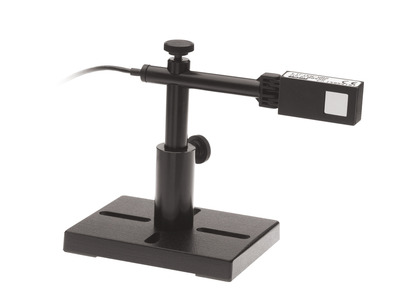
Microscope Slide Power Sensor
Microscope Slide Power Sensor
The PD300-MS microscope slide power sensor measures optical power at the sample plane of a microscope. The silicon photodiode measures from 350-1100 nm at optical powers ranging from 3 µW to 1 W and is designed for the needs of fluorescence excitation measurements. The thin power sensor has a footprint of 76.0 x 25.2 mm matching that of a standard microscope slide. The sensing area is sealed and cleanable, allowing it to easily measure the output of high NA objectives that use immersion medium such as water / oil / glycerol as well as in air.
- Measurement of optical intensity after the microscope objective
- Low angular dependence for high N.A. objectives
- Can be used with air, water or oil immersion objectives See All Features

Specifications
- Aperture Size18 x 18 mm
- MaterialSilicon
- Spectral Range350-1100 nm
- Power Range3 μW to 1 W
- Maximum Average Power Density20 W/cm²
- Response Time0.2 s
- Cable Length1.5 m
- Dimensions76 x 25 x 2.5 mm (LxWxD)
- CE ComplianceYes
- UKCA ComplianceYes
- China RoHS ComplianceYes
Features
Microscope Slide Power Meter Overview
The PD300-MS Microscope Slide Power Meter lets you accurately measure the exact amount of light applied to a specimen, so experimental results across different equipment can be objectively compared.
Measuring Very Low Laser Powers with a Photodiode Sensor
In this short “Basics” video, we review in general the use of photodiode sensors for measuring very low laser powers.
Frequently Asked Questions
- Do I need to recalibrate my instrument? How often must it be recalibrated?Answer
Unless otherwise indicated, Ophir sensors and meters should be recalibrated within 18 months after initial purchase, and then once a year after that.
- How can I measure light coming out of an oil immersion objective?Answer
This is easy with the PD300-MS all you need to do is place a drop of oil on the center of the sensor surface and immerse the objective lens in it. After measurement just wipe down the sensor and clean it for another use.
- The area of the sensor is large, can I measure light at any point on it?Answer
The sensor is large in order to 'catch' light coming out of the objective at large angles, it is most accurate when the light is centered on the surface – you should use the target on the backside of the sensor to position the sensor optimally.
Resources
Data Sheets
Catalogs
Power Sensors Catalog(11.2 MB, PDF) Laser Power & Energy Measurement and Laser Beam Analysis Catalog(27.5 MB, PDF)
Drawings & CAD
PD300-MS Drawing(215.1 kB, PDF)
Tutorials
PD300-MS User Notes(230.3 kB, PDF) Introduction to Laser Power Sensors
Technical Notes
5 Situations Where Laser Performance Measurement is Necessary Effect of Ambient Conditions on Laser Measurements How to Properly Select a Laser Power or Energy Sensor