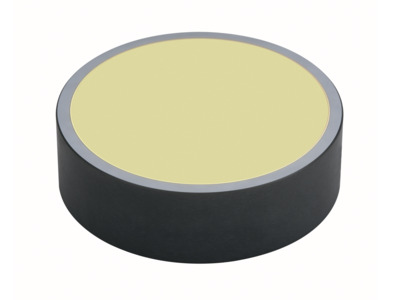
Silicon Zero Phase Shift High Reflection Mirrors
Silicon Zero Phase Shift High Reflection Mirrors
These silicon zero phase shift high reflection mirrors minimize loss of laser power. In addition the phase shift between the s- and p-polarized components of the reflected is as low as possible in order to avoid disturbing the polarization of the laser beam. Silicon mirrors are light weight and are therefore are preferred in flying optics where high accelerations are needed.
- High reflectance to minimize loss of laser power
- Light-weight Silicon substrate for flying optics
- Reflected beam undergoes a 0° phase shift See All Features
| Compare | Description | Drawings, CAD & Specs | Avail. | Price | ||
|---|---|---|---|---|---|---|
 | 61061-117 | |||||
| 61062-117 | |||||
| 61811-117 | |||||
| 62239-117 | |||||
| 630065-117 | |||||
| 630069-117 | |||||
| 630390-117 | |||||
| 630714-117 | |||||
| 630788-117 | |||||
| 631716-117 |
Specifications
- TypeZero Phase Shift Mirror
- Optic MaterialSilicon (Si)
- Angle of Incidence45º
- S1 RadiusPlano
- S2 RadiusPlano
- Phase Shift Tolerance0º ±2º
- Surface Quality10-5 scratch and dig
- Surface Irregularity1 Fringes @ 633 nm
- Power2 Fringes @ 633 nm
- Diameter Tolerance+0 / -0.12 mm
- Thickness Tolerance±0.25 mm
- Wedge<3' (arc minutes)
Features
Zero Phase Shift Mirrors
In most laser machines, one or several mirrors are used to forward the laser beam from the cavity to the working head. Usually, each mirror deflects the laser beam at an angle of 90°, corresponding to an angle of incidence of 45°. At these mirrors, reflectance should be as high as possible in order to minimize loss of laser power. In addition, phase shift between the s- and p-polarized components of the reflected beam should be as low as possible in order to avoid disturbing the polarization of the laser beam. Mirrors with such properties are called zero-phase mirrors
Zero Phase Shift Mirror Coatings
The optical properties of a mirror (reflectance, phase shift, etc.) are determined by its coating. In order to realize different mirror functions, different coatings are needed.
The new Zero Phase Shift High Reflection (ZPS-HR) coating features lower absorption by 40% compared to standard ZPS/TRZ coating. Maximum absorption of the ZPS-HR version coating is 0.3%, an improvement to the standard ZPS absorption level of 0.5%.
MMR-P coating can be used for zero phase shift mirror or cavity optics, and allows for the highest total random polarization reflection available. It can also be applied to a level-changing mirror in two-tiered resonator systems. Our MMR-P coating keeps the same capabilities of phase shift and high reflection of visible light to enable clear observation of HeNe laser or diode laser beam reflection for alignment, location indication, etc.
| Coating | Substrate | %R@45°@10.6 | %S-Pol@45°@10.6 | %P-Pol@45°@10.6 | %R@45° | Phase Shift@45° |
|---|---|---|---|---|---|---|
| ZPS | Si&Cu | 99.5% | - | - | ≥80%@630-670 nm | 0°±2° |
| ZPS-HR | Si | 99.7% | 99.8% | 99.6% | ≥80%@630-670 nm | 0°±2° |
| MMR-P | Si&Cu | ≥55%@900-1000 nm | 0°±2° |
Resources
Catalogs
Laser Optics Catalog(487.6 kB, PDF)
MSDS
Silicon Mirror Material Safety Data Sheet(33.9 kB, PDF)