Pyrocam™ IIIHR GigE 160x160 Pyroelectric Array Laser Beam Profiler
Pyrocam™ IIIHR GigE 160x160 Pyroelectric Array Laser Beam Profiler
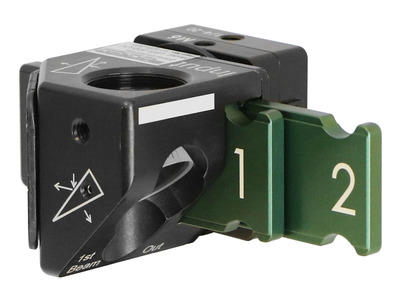
The Pyrocam IIIHR laser beam profiling camera accurately captures and analyzes wavelengths from 13 to 355 nm and 1.06 to 3000 µm with its broadband array. It features a solid state pyroelectric array with a wide dynamic range, fast data capture rates, and operates in CW or Pulsed modes which makes it ideal for analysis of NIR, CO2, and THz sources.
- 160 x 160 pyroelectric array with a 80 µm pitch
- Integrated Chopper for CW Beams
- GigE communication interface
- BeamGage Professional software included See All Features

Software
BeamGage Professional
BeamGage Professional has all of the functionality that BeamGage Standard includes. BeamGage Professional supports all of our beam profiling cameras, includes window partitioning to allow analysis of multiple beams on a single camera, and includes an automation interface written in .NET to push data to your custom applications.
Specifications
- Product NamePyrocam IIIHR
- Spectral Range13-355 nm and 1.06-3000 μm
- Beam Size1.6 to 12.3 mm
- Communication InterfaceGigE
- Sensor TypePyroelectric Array
- Compatible Light SourcesCW, Pulsed up to 1KHzk
- Active Area12.8 x 12.8 mm
- Elements160 x 160
- Effective Pixel Pitch80 µm
- Dynamic Range60 dB
- Full Resolution Frame Rate100 fps
- Saturation IntensityChopped Mode: 3.0 W/cm2 (25 Hz) and 4.5 W/cm2 (50 Hz)
Pulsed Mode: 15 mJ/cm2 - SoftwareBeamGage Professional
- CE ComplianceYes
- UKCA ComplianceYes
- China RoHS ComplianceYes
Features
Pyrocam Pyroelectric Beam Profiler Camera Overview
BeamGage® Laser Profiling Software
BeamGage® comes in two versions: Standard and Professional. Each builds off of the next adding additional capability and flexibility as needed for adapting to almost any configuration requirement. The software performs rigorous data analyses on the same parameters, in accordance with the ISO standards, providing quantitative measurement of numerous beam spatial characteristics. Pass/Fail limit analysis for each of these parameters can be also applied.
BeamGage® Software Measurements
- ISO Standard Beam Parameters
- Dslit, Denergy, D4σ
- Centroid and Peak location
- Major and Minor Axis
- Ellipticity, Eccentricity
- Beam Rotation
- Gaussian Fit
- Flat-top analysis / Uniformity
- Divergence
- Pointing stability

Laser Beam Profiler Accessories
When performing beam profiling measurements on a laser, it is sometimes necessary to manipulate the beam in order to achieve a signal that is suitable to be measured. Occasionally, the beam needs to be sized correctly by either increasing it if it is too small, or increasing it if it is too large. Often times, the laser’s power needs to be reduced to a certain level to be imaged. Our laser beam profiler accessories allow you to achieve proper beam sizes and power levels so that you can achieve the most accurate measurements possible.
Designing Laser Beam with BeamMaker
BeamMaker helps engineers, technicians, and researchers understand a beam's modal content by creating a theoretically generated beam. Design your perfect beam profile in BeamMaker by specifying the mode, size, width, height, intensity, angle, and noise content - then configure your laser to run the as designed, and compare your actual beam to the theoretically derived measurements. The end result is knowledge about how much the real beam varies from the desired beam.
Fundamentals of Laser Measurement & Beam Profiling
Is your laser's beam profile shaped correctly for your application? This video teaches the fundamentals of laser beam profiles and discusses the benefits of profiling your laser beam. Several case studies are presented showing before and after laser beam profiles.
Measuring Laser Focus Spot Size in an industrial Medical Device Application
This step-by-step tutorial will show you how to set up a camera-based beam profiling system on an industrial single-pulse laser welding system. It will also demonstrate for you how to simultaneously analyze the laser's focused spot, measure the laser's energy per pulse, and measure its temporal pulse shape.
Frequently Asked Questions
- What is the saturation level of the PY IIIHR camera?Answer
The saturation power for the Pyrocam IIIHR in chopped mode is 3.0W/cmᒾ (25Hz) and 4.5W/cmᒾ (50Hz) and the Saturation energy in pulsed mode is 15mJ/cmᒾ.
Follow this link and input your laser parameters and you can calculate the your power density. - At what wavelengths is the Pyrocam IIIHR most responsive?Answer

- What is the distance from the front of the camera to the sensor?Answer
The sensor is centered around 15.15mm, however, if the accuracy of its placement is critical, measurements are available upon request.
- What is the framerate of the Pyrocam IIIHR?Answer
25/50Hz chopped mode, SS-100Hz pulsed mode consecutive, up to 1kHz pulse mode non-consecutive
The effective frame rates listed in BeamGage specification sheets are the maximum rates typically achievable in actual use. Frame buffering, image processing techniques, graphical displays, and mathematical computation all add degrees of overhead to achieving higher frame rates. This can be further limited by the available PC hardware. BeamGage features two modes, Frame Priority and Results Priority, which change how the system balances the work. Results Priority acquires a frame, performs any enabled image processing, performs all calculations and updates the graphical displays before accepting another frame from the camera. This mode is most useful when a temporal sequence of frames is not necessary and should always be enabled when logging. Frame Priority mode will allow the calculations and graphical display updates to be interrupted if another frame is ready from the camera before those operations are complete. This can be useful when collecting all frames at the maximum camera frame rate is necessary. - What beam sizes can I measure with the Pyrocam IIIHR?Answer
1.6mm - 12.3mm
The accurate beam size minimum is derived by the pixel size of the camera. In order to get an accurate measurement, there must be enough coverage of pixels to ensure that illuminating another pixel will not over exaggerate the beam size.
Follow this link to find out more.



Resources
Data Sheets
Pyroelectric Array Cameras Datasheet(456.3 kB, PDF) BeamGage Datasheet (647.6 kB, PDF)
Drawings & CAD
Pyrocam IIIHR Drawing(247.8 kB, PDF)
Manuals
BeamGage User Guide(10 MB, PDF) BeamGage User Guide - Japanese(6.3 MB, PDF) BeamGage User Guide - Chinese(7.3 MB, PDF) Pyrocam IIIHR User Guide(1,022.3 kB, PDF)
Catalogs
Laser Beam Profilers Catalog (7.6 MB, PDF) Laser Power & Energy Measurement and Laser Beam Analysis Catalog(27.5 MB, PDF)
Application Notes
Videos
1 Introduction to BeamGage Beam Profiling Camera(0:38) 2 Source Tab - Control Acquisition of Laser Data(7:42) 3 Beam Display Tab - Control Display Options(9:21) 4 Capture Tab - Customize Data Collection(7:46) 5 Computations Tab - Adjust Calculations(10:29) 6 Aperture Tab - Define Region of Interest(9:40) 7 BeamGage Charts, Logging and Reports(4:26) 8 BeamGage Setup Configuration(5:04) 9 BeamGage Beam Width Calculations(2:25) 10 BeamGage Ultracal and Apertures(5:35) 11 BeamGage Camera Resolution(4:15) 12 BeamGage Weak Beam Strategies(2:03) 13 BeamGage Tips and Tricks(4:41) 14 BeamGage Camera Setup Example(12:52) BeamGage Tutorial: Automation(10:29) BeamGage Tutorial: Beam Attenuation(4:25) BeamGage Tutorial: Camera Quick Start(3:41) BeamGage Tutorial: Getting Started with BeamGage(17:04) BeamGage Tutorial: Help System(3:28) BeamGage Tutorial: Power/Energy Measurement Integrated(5:44) BeamGage Tutorial: Spot Size and Divergence(7:52) BeamGage Tutorial: Tabs and Ribbons(13:23) BeamGage Tutorial: Ultracal(3:33)
Technical Notes
Pyroelectric Technology in Laser Sensors and Beam Analyzers Integrated Solutions Installing the Pyrocam III The Focal Length Divergence Measurement Method BeamGage Professional Partitions with Multiple Beams on One Display Understanding Dynamic Range…The Numbers Game
Technical Articles
LIDAR Guns, Accuracy, and Speeding Tickets Imaging UV light with CCD Cameras Which Camera Technologies Work Best for Beam Profiling Applications