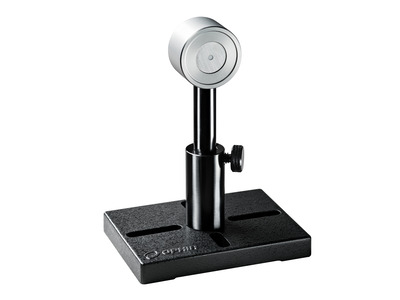
PD300RM-UVA LED and Laser Radiometer
PD300RM-UVA LED and Laser Radiometer
The PD300RM-UVA sensor has a flat spectral response which allows measurement of narrowband and broadband sources (LEDs, lasers) in the spectral range, without the need to know the exact wavelength. Broadband source (LED) measurement is not affected by the source bandwidth or wavelength shift due to heating. The sensor also allows measuring sources at different wavelengths simultaneously.
- Special filter for flat spectral response from 350 to 450 nm
- Small aperture of 2.75 mm
- Cosine corrected response achieved by a PTFE diffuser
- Irradiance and dosage measurement with 500 Hz sample rate
- UV resistance cable See All Features
Specifications
- Irradiance Range1.5 µW/cm² - 15 W/cm²
- Spectral Range350-450 nm
- Maximum Average Power Density50 W/cm²
- Aperture SizeØ2.75 mm
- DimensionsØ35 x 21 mm
- Response Time0.2 s
- f'2 Cosine Correction Factor Accuracy6.5%
- Thermal Coefficient-0.03%/°C
- CE ComplianceYes
- China RoHS ComplianceYes
- UKCA ComplianceYes
Features
PD300RM-UVA Irradiance and Dosage Sensor Overview
Now you can measure irradiance and dosage in applications using broadband UV and visible LEDs. In this short video, you’ll learn what the Ophir PD300RM-UVA does, and how to use it.
Measuring LED Irradiance and Dosage with the PD300RM
Does your application involve irradiating a target surface with an LED? UV curing of adhesives is one example of such an application. Ophir’s new PD300RM sensor family measures irradiance and dosage for UV and Visible LEDs. This video explains what the PD300RM does, what is so unique about it, and how to use it.
Measuring Power of LEDs: UV, Visible and NIR
Measuring the emitted power of an LED can be tricky. It is different in some important ways from measuring the power of a laser beam. This video shows you how to use the Ophir 3A-IS Integrating Sphere Sensor, along with the Auxiliary LED accessory, to easily make accurate measurements in LED applications.
Frequently Asked Questions
- Can I measure white LEDs with the PD300RM?Answer
No, white LEDs have wideband spectrum. Try the PD300CIE for illuminance (lux) measurement.
- What is the accuracy of the PD300RM for LEDs and for lasers?Answer
The accuracy when measuring irradiance of laser sources is easy to determine because lasers have very narrow bandwidth and their wavelength is well known. The accuracy for laser measurement is given in the specifications. When measuring the irradiance of LED sources, other issues such as bandwidth and wavelength tolerance come into play. For more details and specifications see the white paper.
- Do I need to recalibrate my instrument? How often must it be recalibrated?Answer
Unless otherwise indicated, Ophir sensors and meters should be recalibrated within 18 months after initial purchase, and then once a year after that.
- What is the purpose of the PD300RM's diffuser?Answer
In order to get a good cosine corrected response, a diffuser is placed in front of the photodiode to convert directional light into lambertian diffused light, thus eliminating any sensitivity to direction.
- Can I measure a mercury lamp with the PD300RM-UV?Answer
No, the PD300RM is a broadband detector. It doesn’t have a filter to isolate specific emission lines such as mercury lamp lines (365nm, 254nm) or spectral bands such as UVA, UVB. Custom solutions with filters are available. Contact Ophir for more information.
- Can I measure a laser with the PD300RM?Answer
Yes, in applications where a laser beam is diverging or diffused, such as laser projectors, PD300RM can be used to measure the irradiance with high accuracy. However, it is not applicable for measuring a collimated laser beam. Use the PD300 for that.
Resources
Catalogs
Power Sensors Catalog(11.2 MB, PDF) Laser Power & Energy Measurement and Laser Beam Analysis Catalog(27.5 MB, PDF)