Bar Code Scanner Photodiode Sensor
Bar Code Scanner Photodiode Sensor
The BC20 bar code scanner photodiode sensor is designed to measure scanned or intermittent beams. It has a swivel mount and a 10x10 mm aperture. It covers the spectral range 400-1100 nm and its power measuring range is 0.1-20 mW.
- Measure scanned beams such as bar code sources
- 400-1100 nm range
- 10 x 10 mm aperture See All Features
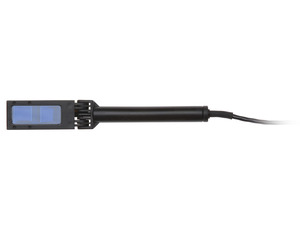
Specifications
- Aperture Size10 x 10 mm
- MaterialSilicon
- Spectral Range400-1100 nm
- Power Range0.1 mW to 20 mW
- Maximum Average Power Density50 W/cm²
- Dimensions118 x 10 x 18 mm (LxWxD)
- Use1.5 m
- CE ComplianceYes
- UKCA ComplianceYes
- China RoHS ComplianceYes
Features
Measuring Power of Scanned Beams Using BC20
In this video, you will learn how the BC20 sensor enables correct power measurement of scanned beams, such as are used in barcode readers, laser shows and similarly challenging applications.
Measuring Very Low Laser Powers with a Photodiode Sensor
In this short “Basics” video, we review in general the use of photodiode sensors for measuring very low laser powers.
Frequently Asked Questions
- What does the PD300 "Background Subtraction" do?Answer
Ophir's Photodiode PD300 and PD300-1W sensors offer automatic background subtraction so the measurement is not sensitive to room light. With "filter out" (i.e. the external filter removed for low light measurements), 2 separate detector elements are visible. The beam to be measured is incident only on the outer of the 2 detectors, but background light reaches both detectors. The instrument will show the power measured by the outer detector minus that measured by the inner detector.This patented method cancels out 95% - 98% of background light under normal room conditions, even if it is constantly changing.
- How does the BC20 measure the true power of a scanned beam?Answer
The BC20 has a peak measurement and hold circuit which measures the peak power on the detector and holds it. Therefore when a beam is scanned over the detector, when the beam is on the detector it goes up to a peak which corresponds to the same power the detector would measure if the beam was stationary and therefore the BC20 reads the correct power whether the beam is scanned or not. In order for the BC20 to do this, the beam must be on the detector (of size 10x10mm) for at least ~13µs and therefore this limits the scanning speed on the detector to 30,000 inch/s.
- Do I need to recalibrate my instrument? How often must it be recalibrated?Answer
Unless otherwise indicated, Ophir sensors and meters should be recalibrated within 18 months after initial purchase, and then once a year after that.
- Why won’t a BC20 sensor work with the StarLite display?Answer
The BC20 sensor was not intended to be used with the StarLite display. If you use the Nova II or Vega display it will work.
Accessories
Swivel Stand
| Compare | Description | Drawings, CAD & Specs | Avail. | Price | ||
|---|---|---|---|---|---|---|
 | 1Z09004Swivel Stand, Photodiode Sensors |
Resources
Data Sheets
Catalogs
Power Sensors Catalog(11.2 MB, PDF) Laser Power & Energy Measurement and Laser Beam Analysis Catalog(27.5 MB, PDF)
Drawings & CAD
BC20 Drawing(95.1 kB, PDF)
Videos
Technical Notes
How to Measure the Power of a Bar Code Scanning Laser What sensor should be used to measure scanning laser beams 5 Situations Where Laser Performance Measurement is Necessary Effect of Ambient Conditions on Laser Measurements
Technical Articles
Are You Safe at a Laser Light Show? Using the Ophir BC20 to Evaluate Scanned Effects in Light Show Applications Ophir Power/Energy Meter Calibration Procedure and Traceability/Error Analysis Laser Measurements in Materials Processing